Week 3: Causal Diagrams: The Structures of Confounding Bias
Date: 11 Mar 2026
Key idea
Which variables to adjust for is a question about causal structure, not about model fit. A regression can fit the data better and still answer the wrong causal question, because $R^2$ cannot detect confounding.
Readings
Required
Optional
Key concepts for the test(s)
- Confounding bias
- Backdoor path
- Backdoor criterion
- Valid adjustment set
- M-bias
- Regression
- Intercept
- Regression coefficient
- Model fit
- Why model fit is misleading for causality
Lab 3 setup
Use Lab 3: Regression, Graphing, and Simulation for this week's practical work. The optional script is here: Download the R script for Lab 03.
Week 2 introduced five elementary causal structures and the rules of d-separation. This week we use those structures to diagnose confounding bias and ask: when does conditioning on a variable remove bias, and when does it create bias?
Seminar
Motivating example: higher $R^2$, worse identification
Suppose investigators want the total effect of an exercise programme ($A$) on cardiovascular risk ($Y$). They begin with a regression that adjusts for baseline confounders. Then they add body composition measured after the programme ($M$). The model $R^2$ rises, because body composition is a strong correlate of cardiovascular risk.
Did the higher $R^2$ improve the causal estimate? No. If the programme changes body composition and body composition changes cardiovascular risk, then $M$ is a mediator on the path $A \to M \to Y$. Conditioning on $M$ blocks part of the very effect the investigators wanted to estimate. The model fits the observed data better, but it answers the wrong causal question.
A simple map for week 3
Week 3 asks one repeated question: which variables should we condition on, and why?
A practical workflow
- Draw the relevant backdoor paths from $A$ to $Y$.
- Decide which variables would block those paths.
- Check that you are not conditioning on a mediator, a collider, or a descendant of treatment.
That is the logic behind the backdoor criterion. Regression is only one way of carrying out the conditioning decision.
Learning outcomes
By the end of this week, you will be able to:
- Define confounding bias and identify it in a DAG.
- Apply the backdoor criterion.
- Explain why good model fit does not rule out confounding.
- Distinguish confounding problems that time ordering can solve from those it cannot.
- Define M-bias and explain why conditioning on a pre-treatment collider can introduce bias.
What is confounding?
Confounding exists when a common cause of treatment $A$ and outcome $Y$ opens a non-causal backdoor path.
Definition: confounding bias
Confounding bias exists when at least one backdoor path from $A$ to $Y$ is open.
A backdoor path starts with an arrow into $A$.
Example: exercise and blood pressure. Health consciousness ($L$) may affect exercise ($A$). Health consciousness ($L$) may also affect blood pressure ($Y$). Then $A \leftarrow L \to Y$ is a backdoor path. If we do not condition on $L$, we mix causal association and spurious association.
Quick test
If a path from $A$ to $Y$ starts with an arrow into $A$, treat it as a candidate backdoor path.
The backdoor criterion
Pearl's backdoor criterion tells us when an adjustment set is valid.
Definition: backdoor criterion
A set $L$ satisfies the backdoor criterion for $A$ and $Y$ if:
- No variable in $L$ is a descendant of $A$.
- $L$ blocks every backdoor path from $A$ to $Y$.
If both conditions hold, conditioning on $L$ supports exchangeability: $Y(a) \coprod A \mid L$.
A short memory aid
- Block all backdoor paths.
- Do not adjust for descendants of treatment.
Pair exercise: applying the backdoor criterion
- Draw a DAG for the effect of exercise ($A$) on cardiovascular risk ($Y$) with three additional variables: health consciousness ($L_1$), diet ($L_2$), and body composition ($M$, a mediator on the $A \to Y$ path). Include arrows: $L_1 \to A$, $L_1 \to L_2$, $L_2 \to Y$, $L_1 \to Y$, $A \to M \to Y$.
- List all paths from $A$ to $Y$.
- Check whether ${L_1}$ satisfies the backdoor criterion. Does it block every backdoor path without conditioning on a descendant of $A$?
- Explain why adding $M$ to the adjustment set violates the backdoor criterion (which part of the causal path does it block?).
Confounding and regression
Regression is one way to condition on measured variables. For example,
$$ Y = \beta_0 + \beta_1A + \beta_2L + \varepsilon $$
Definition: key regression terms
- Intercept ($\beta_0$): expected outcome when covariates are zero.
- Coefficient ($\beta_1$): expected outcome difference per unit change in $A$, conditional on model terms.
- Model fit ($R^2$): variance explained by the fitted model.
High $R^2$ does not imply no confounding. Fit is a statistical property. Confounding is a causal-structure property. A model can fit the observed data very well and still answer the wrong causal question.
Why model fit is misleading for causality
A model can fit very well and still be causally wrong.
If investigators condition on a mediator, they can block part of the target effect.
If investigators condition on a collider, they can open a spurious path.
Neither problem is diagnosed by $R^2$.
Confounding problems that time ordering can resolve
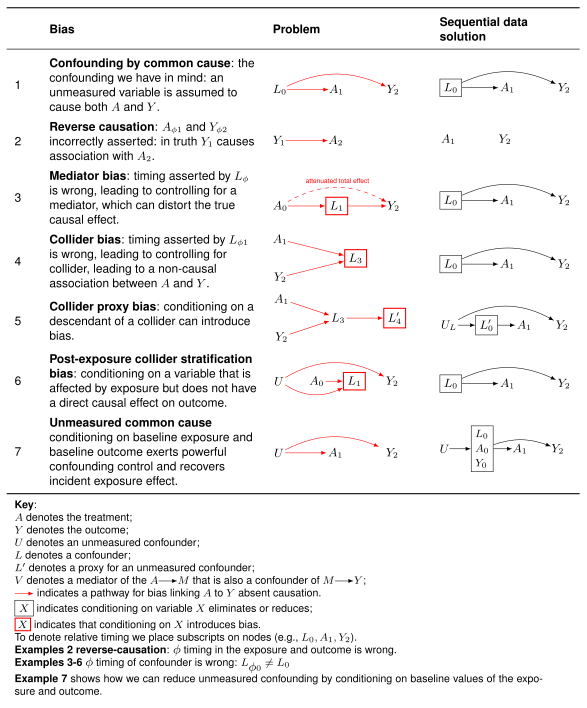
Cross-sectional measurements blur temporal order. Longitudinal design can resolve several ambiguities. A common strategy is:
- Measure confounders at baseline ($t_0$).
- Measure treatment at $t_1$.
- Measure outcome at $t_2$.
Measuring variables in this order rules out two ambiguities at once. The outcome cannot have caused the treatment, because it is measured later. A measured confounder cannot be a consequence of the treatment, because it is measured earlier. Time stamps make the assumed arrow directions checkable rather than merely asserted.
Confounding problems that time ordering alone cannot resolve
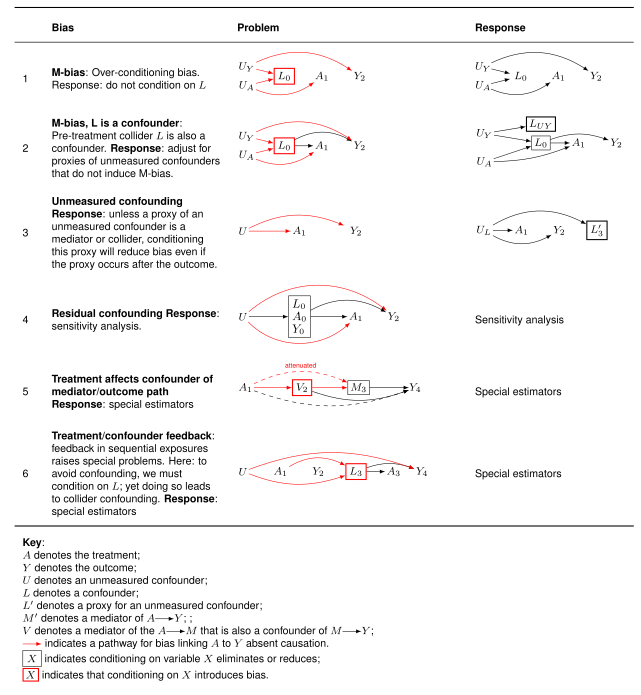
Time ordering fixes the direction of arrows. It does not supply missing variables. If a common cause of treatment and outcome is never measured, for example a stable disposition that drives both, then adding waves does not close that backdoor path: repeated measurement of the wrong variables cannot substitute for measuring the right ones. Time ordering also cannot resolve M-bias, where the offending structure is a pre-treatment collider rather than an open backdoor path.
Definition: M-bias
M-bias occurs when investigators condition on a pre-treatment collider.
In the structure $U_1 \to L \leftarrow U_2$, with $U_1 \to A$ and $U_2 \to Y$, conditioning on $L$ opens a previously blocked path between $A$ and $Y$.
M-bias is important because "control for everything" is not a safe rule.
Pair exercise: M-bias in practice
- Consider the question "does religious attendance increase charitable giving?" Suppose neighbourhood social capital ($L$) is a collider of two unmeasured causes: one that affects attendance ($U_1$) and one that affects giving ($U_2$).
- Draw the DAG with $U_1 \to L \leftarrow U_2$, $U_1 \to A$, and $U_2 \to Y$.
- Trace what conditioning on $L$ does: which path opens?
- State in one sentence why "adjust for all pre-treatment variables" fails here.
Note on mediation assumptions
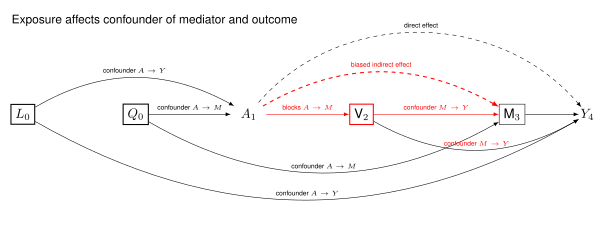
Mediation analysis needs stronger assumptions than total-effect analysis. One reason is treatment-induced confounding: the treatment $A$ can affect a variable that then confounds the mediator-outcome relation, so no fixed adjustment set both blocks the confounding and leaves the mediated path intact. When this happens, standard regression cannot recover the direct and indirect effects. We do not estimate mediation in this course. The point here is only that splitting a total effect into separate paths carries assumptions beyond those needed for the total effect itself.
Return to the opening example
Back to the exercise programme example. Higher $R^2$ did not answer the causal question, because adding post-treatment body composition changed the estimand. To estimate the total effect of the programme on cardiovascular risk, we need a defended DAG and a valid adjustment set, not just a better-fitting regression. This is why we separate modelling from causal identification.
What to remember for the test
- Confounding is about open non-causal backdoor paths.
- The backdoor criterion tells us when an adjustment set is valid.
- Regression can implement conditioning, but it cannot tell us which variables should be conditioned on.
- Better fit is not the same as better identification.
Confounding is one structural threat to causal identification. Week 4 adds two others: selection bias and measurement bias.
Pair exercise: $R^2$ versus identification
- Investigator A adjusts for age, income, and education ($R^2 = 0.42$). Investigator B adjusts for age and conscientiousness ($R^2 = 0.31$).
- Explain to your partner why higher $R^2$ does not imply less confounding.
- Propose a DAG where Investigator A's larger adjustment set introduces bias (hint: include a collider or mediator).
- State what would need to be true for Investigator B's smaller set to satisfy the backdoor criterion.
Further reading
All open access: Bulbulia (2024); Hernán & Robins (2025, 6).
Lab materials: Lab 3: Regression, Graphing, and Simulation
Bulbulia, J. A. (2024). Methods in causal inference part 1: Causal diagrams and confounding. Evolutionary Human Sciences, 6, e40. https://doi.org/10.1017/ehs.2024.35
Hernán, M. A., & Robins, J. M. (2025). Causal inference: What if. Chapman & Hall/CRC. https://www.hsph.harvard.edu/miguel-hernan/causal-inference-book/
Neal, B. (2020). Introduction to causal inference from a machine learning perspective. Course Lecture Notes (Draft). https://www.bradyneal.com/Introduction_to_Causal_Inference-Dec17_2020-Neal.pdf
Suzuki, E., Shinozaki, T., & Yamamoto, E. (2020). Causal Diagrams: Pitfalls and Tips. Journal of Epidemiology, 30(4), 153–162. https://doi.org/10.2188/jea.JE20190192